Different Spiritual Environments
Prof. Johan Malan, Mossel Bay, South Africa (June 2012)
Man is a complex being comprising a spirit, a soul, and a body. Not only is he conscious of the visible and physical world but also of the invisible, spiritual world by which humanity is greatly influenced – both positively and negatively. In an effort to bring about stability in his daily life, man tries to adapt as best he can to what he regards as the positive side of the supernatural world, and to anchor his life there. Only a higher spiritual power can protect him against malicious spiritual influences.
From a biblical point of view, due to the Fall, humanity in its entirety has been spiritually blinded by the devil; consequently all people are affected by a great number of deceptive spiritual influences. Scripture offers a clear solution to this problem, however not all Christians sincerely pursue this solution to these very real dangers. As a result, the spiritual complications faced by humanity are generally greater and more serious than all their other problems, because many of these difficulties originate from the spiritual darkening of their minds.
Committed Christians live in the light of
God’s presence, but ignorance results in many others being caught up in a grey
area of mixed convictions. Complete spiritual blindness prevails in the
deceived non-Christian world which follows a large number of idols, ancestral
spirits or self-appointed spiritual leaders. Furthermore, there are a growing
number of agnostics who deny the existence of the spirit world. Because of
people’s diverging perceptions and experiences they determine their own
context for living, with endless variations of the convictions entertained by
man.
Nevertheless, there are three main existential contexts to which people adapt themselves. The first one is the biblical context of the Christian faith; the second is that of secular humanism which exalts man and denies the existence of God and Satan; and thirdly there is the context of non-Christian religions which originated from the dark world of mysticism.
The Christian context

God created humans in His own image of holiness, but also gave them a free will which would allow them to voluntarily obey and love Him or, if influenced otherwise, to disobey, disregard, and even reject Him. Consequential to the devil’s successful deception of humanity’s founding father and mother, moral perversion and spiritual darkening of the mind set in and became part of the fallen, human nature which has been transmitted to all their descendants (Rom. 5:12).
It is from this fallen state that the Lord has saved us: “And you He made alive, who were dead in trespasses and sins, in which you once walked according to the course of this world, according to the prince of the power of the air, the spirit who now works in the sons of disobedience” (Eph. 2:1-2).
Even those who repent and come over from Satan’s darkness into God’s wonderful light (1 Pet. 2:9), still have to overcome their old, sinful nature with its perverted lusts (Gal. 5:17; Eph. 4:22-24), and have to continue to uncompromisingly contend with Satan’s attacks and temptations. It is of the utmost importance that we put on the whole armour of God, so that we may be able to stand against the wiles of the devil (Eph. 6:11).
A Christian has a highly polarised experience of the reality of his existence, which explains his distinctly antithetic worldview from which the two opposite poles of good and evil should be clearly evident. In the Christian worldview, these two concepts are personified and related to God and Satan, who both have the capacity to influence and motivate people towards a particular end. The way in which we conduct our lives will reflect our basic spiritual disposition as well as the measure according to which we respond to these opposite influences.
A born again child of the Lord finds himself both in a spiritual as well as a secular (worldly) milieu. He has been spiritually quickened and the Lord dwells in his heart by means of the Holy Spirit (John 14:23). He lives by faith and continually strives to expand the kingdom of heaven. Because his new life is in conflict with the principles of the depraved world in which he lives, he has to put off his old nature by identifying completely with the cross of Christ on which the world has been crucified to him and him to the world (Luke 9:23; Gal. 6:14).
A Christian should actively contend against demonic influences which are unleashed against him from a mystical, supernatural sphere (Eph. 6:12). He must continuously guard against the possibility of sin regaining its influence upon him, and for this purpose there are spiritual weapons which have been placed at his disposal: “For though we walk in the flesh, we do not war according to the flesh. For the weapons of our warfare are not carnal but mighty in God for pulling down strongholds” (2 Cor. 10:3-4).
It is critically important for every believer to give priority to the spiritual dimension of his life, and to ensure that he maintains a strong bond with the Lord. He is a sojourner and a pilgrim in a depraved world, one who is in the world but not of the world. The sincerity of the commitment and dedication shown by Christians will manifest in the quality of their lives. Some of them are compromising and allow themselves extensive carnal liberties, while others pursue higher spiritual standards of holiness.
A Christian can restrict the spiritual dimension of his life by neglecting his relationship with the Lord and underestimating the struggle against the world, against sin and his old nature, and over time develop the negative symptoms of spiritual immaturity (1 Cor. 3:1-3). This disposition will render him unfit for spiritual service, cloud his perspective and dull his and discernment ability. Sin and spiritual foolishness are the consequences of this state of mind, which leads to a checkmate situation of spiritual unfruitfulness (Gal. 5:17).
However, we are challenged to avert a situation of this nature, to live pure and holy lives before the Lord and to bear fruit which is consistent with repentance. The day will come when our lives will be weighed to determine how many of our works have value for eternity (1 Cor. 3:8-15). Awards will be given solely for works of this nature.
We should determine the spiritual context and priorities in our lives in such a way that we can continue to pursue the goal of the upward call of God in Christ Jesus (Phil. 3:14). Do you devote enough attention to the unseen things of God’s kingdom which have eternal value? (2 Cor. 4:18).
The secular, humanistic context

The second broad context is that of the secular humanist. According to this approach, all matters, including those of religious nature – and only if he recognises its value in everyday life – should be man-centred and aimed at the liberation and development of humanity. God plays no role in his life, and sinful acts are merely regarded as issues arising from aberrant human behaviour.
In its most extreme form, secular humanism denies the existence of God, as well as the existence of a devil and hell. Man becomes his own god who determines his destiny without any intervention by a higher deity. From a biblical perspective, such a person is without God and without hope in the world (Eph. 2:12). As an existentialist who denies the supernatural dimension, he only lives for the things pertaining to this world. The context of his existence is dominated by matters which seem to be of the greatest importance to him at any given moment. Such matters may be of political, social, economic or moral nature.
Despite their agnosticism, humanists often use churches to advance their cause, provided those churches proclaim a social gospel based on human needs without emphasising supernatural things too strongly. According to them matters such as rebirth, sanctification, prayer and a personal relationship with the Lord should not be emphasised or enforced. The church should be nothing more than a moral advocate for human rights, dedicated to uplifting the oppressed and the poor. Primarily, it should be social injustice (strained relations between people) which is addressed, rather than focusing on sin (a strained relationship with God).
Theologians at the helm of such churches readily comply with this approach and they soon join ecumenical bodies which pursue visible multireligious unity, at the expense of dogmatic purity on spiritual matters. Membership of the World Council of Churches (WCC) and its affiliated bodies, as well as ties with the Vatican, the Eastern and African religions, are all part of the ecumenical process.
The spiritual shallowness and compromise made by these theologians and pastors is very obvious. Soon, they no longer regard the Bible as the inspired Word of God and consequently they disregard the Messianic prophecies in the Old Testament, question the virgin birth and deity of the Lord Jesus and reject being born again as the requirement for entrance into the kingdom of God. The importance of religion is downplayed to the level of moral and ethical matters, while the Bible is considered to be merely a collection of mythological accounts. Ultimately, the intellect of man is regarded as his most important attribute which will enable him to secure his own salvation. That is in essence, the doctrine of humanistic self-justification.
The devil is delighted with the ideology of secular humanism. He is not in the least perturbed by the fact that people deny his existence, as long as they simultaneously deny God. Effectively, this assured the devil control of fallen man’s nature, allowing him to offer all sorts of secular ideas to man and to stimulate man’s immoral carnal lusts. Sinful lusts for money, pride, self-conceit, liquor, and disorderly sexuality are encouraged with the intent of inducing people to enjoy unbridled liberties.
A new development occuring in the camp of secular humanists is that of cosmic humanism. Under the banners of the New Age Movement, humanistic psychology, parapsychology, the Human Potential Movement, psychic techniques such as mind over matter, transcendental meditation, alternative healing, positive thinking, visualisation, extra-sensory perception, clairvoyance, occult prophesying, and many others, cosmic powers are being harnessed to solve personal problems and enhance people’s quality of life. People use these techniques to render themselves little gods who are able to discover and develop their full potential and thereby escape the limitations of their past.
In this way, the secular context is merged with the mystical context, which finally prepares deceived humanity to accept and follow the cosmic Christ (the Antichrist) when he appears on the scene to unite all religions.
Our command is to resist the move towards the dark world of mysticism and the rise of the cosmic Christ, while observing a purely biblical worldview, thereby fulfilling our calling to be the salt of this depraved earth. People who do not turn to Christ as their refuge are walking in darkness and are in great danger. If they persist in their wrong ways they will receive strong delusion to believe Satan’s lies (2 Thess. 2:8-12).
The Mystical context

The third general context is that of the false religions which all originated in the occult sphere of mysticism. Through them, Satan advances the interests of his kingdom on earth, and purposefully prepares humanity to accept, worship and follow him and the false, end-time Christ (the Antichrist).
In the non-Christian religions, people are estranged from the true God because their unpardoned sins form a wall of separation between Him and them (Isa. 59:2). They are spiritually dead and resort to false religions in an effort to appease the spiritual hunger of their souls. However, the experiences they have and the rituals they perform have nothing to do with God, having emerged from the grey world of mysticism.
Satan and his empire of demons are active in all the false religions, regardless of the form of a particular faith or the names of the idols or spirits that are worshipped. False religions should, therefore, not be viewed as being illusions which should only be attributed to the free flights of people’s imagination. Demonic powers are at work behind the idols that are worshipped and honoured. The overt symbols are merely the camouflage used by demons, and for that reason Christians should have nothing to do with them. Paul is very clear about this danger:
“What am I saying then? That an idol is anything, or what is offered to idols is anything? Rather, that the things which the Gentiles sacrifice they sacrifice to demons and not to God, and I do not want you to have fellowship with demons” (1 Cor. 10:19-20).
In the mystical faiths there is no clear distinction between the natural and supernatural spheres. Everything merges into a bigger whole, and most rituals or objects are regarded as imbued with mystical powers. Spiritual influences and magical powers are very much a part of everyday life. All diseases, accidents and extraordinary events, as well as success stories and natural phenomena, are viewed as manifestations of the magically and spiritually charged world in which we live. People are faced with the big challenge of manipulating these powers, to use them to their advantage, and also to safeguard themselves against the harmful influences of malevolent magic, or witchcraft, by using protective amulets and other magical means.
Cultures in which a mystical worldview is entertained are fatalistic and stagnant. The principle of natural cause and effect is only recognised to a very limited degree, since most events are ascribed to supernatural causes. In cases of disease, preference is given to divination by a magician or traditional healer, as well as the use of magical therapy, rather than resorting to scientific diagnoses and the use of modern medicine. Even when the latter methods are followed, they are simply regarded as supplementary to traditional methods.
A lack of interest in research and the systematic gathering and processing of empirical knowledge on a wide range of subjects accounts for the slow increase in knowledge, the absence of an effective infrastructure for education and training, the lack of technological progress, and the fact that people become even more dependant on intervention by supernatural powers. Africa is firmly in the grip of the predominantly mystical belief system which has controlled most of its inhabitants for thousands of years, thus impeding sustained development.
The Western world also passed through its Dark Middle Ages when superstition and allegiance to a mystical world of magical powers largely stifled any initiative for research and development. Plato’s unbiblical and poorly defined belief in supernatural powers opened the door widely to mysticism in Europe, which resulted in many of the negative consequences mentioned above.
It was not until the Church Reformation, and particularly the great Christian revivals of the 18th and 19th centuries, that large numbers of people in Europe were delivered from their mystical superstitions. They were spiritually and intellectually liberated, became enlightened in their minds and came to understand correctly the biblical reason for them having been created as human beings. They were delivered from Satan’s mystical, supernatural kingdom when they entered into the right relationship with God through Jesus Christ. From this perspective they were able to correctly understand the earth and its natural laws, and to investigate it further. They were thus enabled to assert authority over the natural creation and to have dominion over it (in keeping with the command of Genesis 1:28 to develop cultural institutions).
The millions of mystically orientated people who are still bent on supernatural signs and wonders will spontaneously accept and follow the Antichrist, since his coming will be “according to the working of Satan, with all power, signs, and lying wonders, and with all unrighteous deception among those who perish” (2 Thess. 2:9-10). Virtually all people will eventually, to their own downfall, allow themselves to be deceived by the satanic triumvirate who will make ample use of demons to mislead their victims (Rev. 16:13-14, 16).
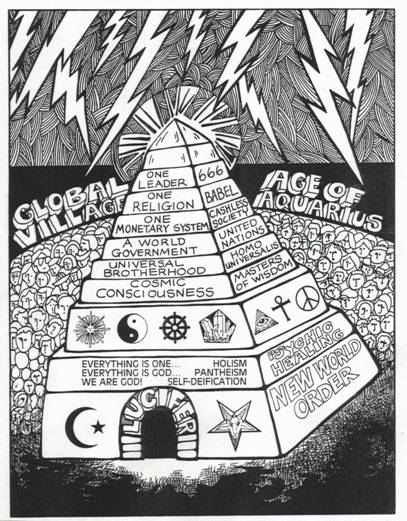
It should be clearly stated at this point, that the mystical influences of Satan and his kingdom are not confined exclusively to the non-Christian religions. There are numerous nominally Christian churches and movements that have been deceived by the enemy in exactly the same way. Because of their deluded minds and spiritual bankruptcy, these people were not aware of the impending danger when the devil infiltrated their fellowships like an angel of light to plant his false prophets among them (2 Cor. 11:13-15; Matt. 7:21-23). In their deceived state they, in turn, are preparing the way for the coming Antichrist through the practice of false signs and wonders.
Mystery, Babylon the great, the mother of all the false religions (Rev. 17:5), is grounded in the dark, mystical world of Satan, and is now engaged in establishing an ecumenical parental organisation offering a home to all apostates on earth. Among these are the apostatised, deformed “Christian” churches eager to join hands with the non-Christian world because they have become estranged from the true Christ of the Bible.
The new world order
Many people are strongly convinced that a new world order of international unity and harmony among all faiths and political ideologies will soon materialise. A precondition is that all governments need to accept the idea of a world government and place themselves under its authority. In accordance with this, the ecumenical movement must promote a mystical brotherhood among all faiths.
For this to take place, it is imperative that evangelical Christianity abandon its uncompromising biblical views and join hands with the non-Christian religions, or be willing to face the risk of persecution. The mystical worldview of the New Age Movement, referred to as cosmic holism, must be accepted as the foundation for co-operation and unification by all concerned. Secular humanism’s discovery of the human’s inherent psychic (or cosmic) powers, brought about by the Human Potential Movement, is already guiding the movement in a mystical direction by reforming itself towards cosmic humanism.
Once the united mystical movement has firmly established itself, and has incorporated the deceived Christian churches by means of a false revival of mystical powers, the time will be ripe for the revelation of the Antichrist. He will be the messiah of the entire deceived world, and together with Satan, will be worshipped by all the subjects of his global empire (Rev. 13:4).
It is of the utmost importance that we should be mindful of Satan’s alternative kingdom, as all people are involved in a battle of life and death against this evil kingdom.