Admonitions by Christ to His Church
Johan Malan, Mossel Bay, South Africa (March 2015)
Through His letters to the seven churches in Asia Minor the Lord Jesus teaches the entire church on earth how to persevere on the evangelical way of the pure Christian doctrine (Rev. 2 & 3). In His messages He warns against the many deviations from the straight road which are offered to believers through both subtle and glaring deception, as well as the relentless persecution of the truth which the church has faced throughout the centuries. He exhorts us to stand firm by not being forced on a wayward course, thereby ensuring that we finish the race as overcomers. From these short but powerful letters it is obvious that only a minority of believers will be among the overcomers, and this underscores the importance of admonitions against serious deception originating from within and also outside of the church, as well as opposition by a hostile world which lies in the sway of the Evil One. The following are the most important cautions in the seven letters:
Ephesus: A humanistic form of godliness which is self-defeating
|
|
|
|
|
The light of Christ’s gospel was established in the church in Ephesus and initially shined brightly. |
Subsequently, false teachers sneaked in and deceived the members (Acts 20:28-30). |
Eventually, the congregation disbanded and the church building later fell in ruins. |



The church in Ephesus made a good start under the leadership of Paul, and the people were moved by the love of Christ to give their hearts to Him and become members of a Christian congregation. The pure Christian doctrine was proclaimed here, as evidenced by Paul’s epistle to the Ephesians, and everything which was at variance with it was rejected. The lampstand with its oil depicts the Holy Spirit who shined brightly and guided the congregation into all truth.
In course of time, a form of godliness set in which prompted members to only agree intellectually with the good confessions of the church without a spiritual experience of meeting the Lord Jesus through the Holy Spirit. Consequently, testimonies on rebirth and the filling of the Holy Spirit became rare occurrences as members were only followers of the church with its pastor who declared them saved. They still used the name of the Lord Jesus but He was not a reality in their lives. They rejected false doctrines but only because they clashed with those of their own church. In the process, love for Christ dwindled and was replaced by love for the church, while the fruit of the Spirit was replaced by human works done through own initiative and only in the interest of their own congregation. They were still active members, even in the midst of persecution, but only paid lip service to Christ (cf. Matt. 15:8-9).
In His letter the Lord Jesus praised the congregation for the good things they did, but warned that they were busy losing their spiritual foundation: “I know your works, your labour, your patience, and that you cannot bear those who are evil. And you have tested those who say they are apostles and are not, and have found them liars; and you have persevered and have patience, and have laboured for My name’s sake and have not become weary. Nevertheless I have this against you, that you have left your first love. Remember therefore from where you have fallen; repent and do the first works, or else I will come to you quickly and remove your lampstand from its place – unless you repent” (Rev. 2:2-5).
Christ had become a stranger in this exemplary congregation. The love which people have for other people and also for their church, can never be a substitute for God’s agape love which is poured out in our hearts by the Holy Spirit (Rom. 5:5). When you are no longer grounded and rooted in this love you do not have a relationship with Jesus Christ, even if you confess His name with your lips. When a Christian church loses its spirituality and backslides into a humanistic form of godliness, the Lord calls the members to repent from their fallen state. If they do not respond to this call the church will lose its lampstand and slide into even greater darkness. That is exactly what happened to the church in Ephesus, and they were ultimately forced to close their doors.
Smyrna: Intense struggle against an evil and hostile world
|
|
|
|
|
Countless Christians were im-prisoned for their faith. It still happens today. |
New Testament times are charac-terised by intense hostility against the Bible as God’s Word. |
Many Christians paid the highest price for their faith, often in the most gruesome ways. |



In this letter the Lord Jesus warns that the church dispensation should not be equated with a kingdom situation as we are living in a world which lies in the sway of the Evil One. The devil is the big adversary of Christ and His church, and that demands extensive spiritual defence from members. However, in Christ the devil is a conquered enemy, and even if Christians have to die as martyrs their future is sure and firm. Jesus says in this letter: “Do not fear any of those things which you are about to suffer. Indeed, the devil is about to throw some of you into prison, that you may be tested, and you will have tribulation ten days. Be faithful until death, and I will give you the crown of life” (Rev. 2:10).
The ten days refer to the reign of ten successive Roman emperors who all persecuted the Christians and tried to destroy them. They were henchmen of the devil. However, the persecution of Christians did not end during the fall of the Roman Empire but was perpetuated by the Roman Catholic Church as well as pagan nations under the control of false religions. Periods of severe persecution came and went, but never permanently ceased. During the coming tribulation period, persecution will again flare up to reach new heights. In Revelation 6:9-11, John refers to the end-time martyrs during the tribulation period.
Even in countries where there is no physical oppression and persecution of Christians, believers are still engaged in an intense struggle against the devil and his temptations. This is the reason why we are commanded to take up the full armour of God to be able to remain standing against the wiles of the devil (Eph. 6:10-12; 2 Cor. 10:3-5). Evangelical Christians are often shunned in society and regarded as persona non grata; that is why Paul says that “all who desire to lead a godly life in Christ Jesus will suffer persecution” (2 Tim. 3:12). In His letter to Smyrna the Lord Jesus encourages us to remain true to Him in the midst of all the tribulation – even unto death.
Pergamos: Compromise with false religions and worldly wisdom
|
|
|
|
|
The doctrine of Balaam is a Babyl-onian type interfaith action in which differences make room for unity. |
Multireligious organisations proliferate in the end-time and at present enjoy worldwide support. |
Interfaith structures thrive around the rejection and breaking of the cross. |
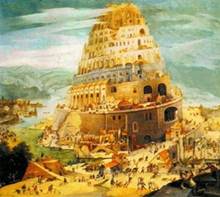


In the church in this city there was a small group of faithful disciples who took a bold stand for the truth of Christ and His gospel. Pergamos is described as the place “where Satan’s throne is” (Rev. 2:13). The city had a large number of heathen temples, and also one for the worship of Caesar Augustus. The situation there provides further evidence of the large degree of control which satanic powers have gained over the depraved world during the church age. To reach this goal the devil changes his appearance and mostly comes in the guise of an angel of light to deceive people and convince them that there is nothing wrong with the non-Christian religions, that they actually complement the Christian faith and should therefore be fully recognised.
Furthermore, a pagan philosophy formed the basis of the nation’s educational system. The city boasted a university with a collection of 200 000 books, mostly inclined towards Greek philosophy. Polytheism (a belief in many gods) was promoted, as well as Plato’s metaphysics which gave rise to a belief in undefined supernatural forces, including witchcraft. This fallacious philosophy was the contributing factor to the spiritual decadence of the dark Middle Ages, which also accounts for Europe’s long-standing belief in witchcraft. Thousands of people were executed on suspicion of being witches.
The Christian church in Pergamos was under immense pressure to compromise and openly associate with the non-Christian religions. The Lord refers to this compromise as “the doctrine of Balaam, who taught Balak to put a stumbling block before the children of Israel, to eat things sacrificed to idols, and to commit sexual immorality” (Rev. 2:14). According to Numbers 22 to 24, Balaam was hired by Balak, king of the Moabites, to pronounce a curse upon Israel. However, Balaam refused to do so and instead persuaded Balak not to resort to curses and military confrontation, but to tempt Israel by means of compromise to partake in the feasts of Baal.
This strategy brought success, and we read in Numbers 25 that Israel accepted an invitation to attend a feast in honour of Baal in Moab, where they compromised with a pagan religion and paid homage to a foreign god. In modern times it is also evident that Satan is causing havoc among Christians by applying his strategy of compromise. According to Peter, this approach is characteristic of false preachers in the end-time, who fell away from the truth: “They have forsaken the right way and gone astray, following the way of Balaam the son of Beor, who loved the wages of unrighteousness” (2 Pet. 2:15).
If these people don’t repent from their multireligious thinking and compromise with the world, the Lord will fight against them with the sword of His mouth – that is His Word. The Bible strongly denounces such associations: “Do not be unequally yoked together with unbelievers. For what fellowship has righteousness with lawlessness? And what communion has light with darkness? And what accord has Christ with Belial? Or what part has a believer with an unbeliever? … Therefore, come out from among them and be separate, says the Lord. Do not touch what is unclean, and I will receive you” (2 Cor. 6:14-17). Only deceived nominal Christians who no longer believe in the uniqueness of Jesus and the full significance of His atoning death (cf. 1 John 2:22), can conclude a covenant with the non-Christian faiths. To Christians there is only one way of salvation (John 14:6; Eph. 1:7).
Thyatira: the corrupting influence of false prophets in the church
|
|
|
|
|
False prophets often promote a false concept of God, in which the deity of Jesus is denied. |
In many cases prophetesses played a major role in spiritual deception and are still popular. |
In modern deception, bridges are built between the all the major world religions. |
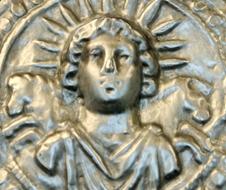


This church also consisted of a mixture of faithful and unfaithful members, of which the latter fell very far away from the truth. Jesus said: “I have a few things against you, because you allow that woman Jezebel, who calls herself a prophetess, to teach and seduce My servants…” (Rev. 2:20). False prophets and prophetesses were always the cause of large-scale deception – from Old Testament times until today. Such prophets usually claim a so called unique source of information which the Lord revealed to them through dreams, visions, crystal balls, voices talking to them, or messages delivered by angels. These seers add further information to the biblical revelation by prophesying events that will occur at a specific time (e.g. war or revival in one or other country), or they deny certain biblical statements, e.g. that there will be an Antichrist or a battle of Armageddon.
False prophets are also known for their dispensational confusion in that some of them are inclined to continue the previous dispensation of the law, while the largest group are preoccupied by the future dispensation of the kingdom during Christ’s millennial rule, and then erroneously apply these prophecies to the church dispensation. While doing so they promote a kingdom transformation during the church age, which is characterised by Christian dominion as well as signs and wonders. False prophets are also responsible for different definitions of the term “Israel”, of which British Israelism is one of several. They often subscribe to erroneous concepts of God, ranging from the denial of the Trinity and the deity of Jesus to the universal God of all faiths.
The prophetess in Thyatira promoted an interfaith approach by trying to convince believers to join with the religious feasts of the pagans, and in so doing worship their “common God”. This ecumenical doctrine is still proclaimed by false prophets, and their purpose is to achieve religious unity on earth in preparation for the appearing of the false messiah of all faiths, who will be worshipped by all people (Rev. 13:3-4). The Lord’s judgements rest upon the false prophets, and the last warning in the Bible refers to them. Jesus said that if someone takes away from biblical prophecies, God will remove his/her name from the book of life; and if anything is added to the divine revelation, God will add His plagues to that false prophet (Rev. 22:18-19).
The Lord promises to those who have overcome all the deception and distorted teachings of the false prophets, that they will be co-heirs of His everlasting heavenly kingdom: “Now to you I say, and to the rest in Thyatira, as many as do not have this doctrine, who have not known the depths of Satan, as they say, I will put on you no other burden. But hold fast what you have till I come. And he who overcomes, and keeps My works until the end, to him I will give power over the nations – he shall rule them with a rod of iron; they shall be dashed to pieces like the potter’s vessels – as I also have received from My Father; and I will give him the morning star” (Rev. 2:24-28).
All those who contend earnestly for the truth and abide in it, have Jesus Christ in their hearts. He is the way, the truth and the life, and as the Bright and Morning Star He is Himself the promise of a glorious new day that will dawn upon this dark world. Believers who remain true to Him despite all the persecution and hardships will rule over the nations together with Him in His reign of peace. All those who denied Him will spend eternity together with His enemies in a place of everlasting torment.
Sardis: Churches that die spiritually
|
|
|
|
|
A dilapidated church overgrown by weeds. The congregation disbanded and the building became redundant. No songs of praise are heard here. |
A deserted church building, displaying the message of “Ichabod”. Only a gloomy silence prevails inside. |
New memorial stones which reflect on bygone days are frequently erected in the cemetery of dead churches. |


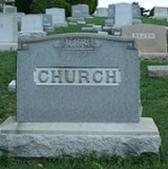
The spiritually stagnated church of Sardis is afforded the opportunity to correct what has gone wrong in their spiritual life, and to be re-established in the truth which they heard at the beginning: “These things says He who has the seven Spirits of God and the seven stars: I know your works, that you have a name that you are alive, but you are dead. Be watchful, and strengthen the things which remain, that are ready to die, for I have not found your works perfect before God. Remember therefore how you have received and heard; hold fast and repent. Therefore if you will not watch, I will come upon you as a thief, and you will not know what hour I will come upon you” (Rev. 3:1-3).
This congregation had spiritually completely fallen asleep, and ultimately they were only nominal Christians with no testimony of walking with the Lord. They had the name that they were alive but, like the lost son, they wandered away very far from their Father’s home and lost all contact with Him (Luke 15:32). The churchgoers in Sardis stopped nourishing themselves from the fountain of living water, and that explains the withering away of their spiritual lives until many of them eventually died in their hearts. They are called upon to urgently discover their appalling condition of spiritual deadness and to wake up: “Awake, you who sleep, arise from the dead, and Christ will give you light” (Eph. 5:14). When they would return to the gospel message as they had originally received it, they would awake spiritually. Only then would they be able to reach out to the multitudes around them who faced eternal death because they had not yet settled their case with the Lord. The church first had to be revived spiritually before they would have open eyes to see the spiritual need of those around them, and to do something about it.
There was a small core group in the congregation who had not backslidden from the Lord and lapsed into spiritual passivity. One day, they will be shining lights in Christ’s revealed kingdom. He says to them: “You have a few names even in Sardis who have not defiled their garments; and they shall walk with Me in white, for they are worthy” (Rev. 3:4). They did not, like other backsliders, begin in the Spirit and end in the flesh (cf. Gal. 3:3).
Philadelphia: The struggle against deception and rejection can be won
|
|
|
|
|
There were always a number of small evangelical churches that did not apostatise but persevered under difficult circumstances. |
Paul was not the only faithful preacher who encouraged believers from his prison cell to remain true to Christ. |
The true church of Christ may be small and despised, but it is like a tree planted by the waters – it is alive and fruitful. |

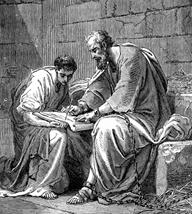

Philadelphia was a truly evangelical congregation that feared the Lord and honoured His Word. Because of their strict moral and spiritual principles they were not popular in the wider society, and consequently did not have many members or a high income. Due to their small size and other limitations they had little influence and could only trust the Lord for the opportunities and means to be able to proclaim His Word. However, Christ gives them the assurance that He would empower them to do His work as He was the One who could open or close doors: “These things says He who is holy, He who is true, He who has the key of David, He who opens and no one shuts, and shuts an no one opens: I know your works. See, I have set before you an open door, and no one can shut it; for you have little strength, have kept My word, and have not denied My name” (Rev. 3:7-8).
The basic reason why this congregation enjoyed the blessings of the Lord was because they kept His Word and did not deny His Name. Many of the apostates during that time, as is the case today, no longer accepted and honoured the Word of the Lord as they did when they originally heard and received it. By the year 95 AD most of the books and epistles of the New Testament were already being circulated among the various churches. John’s book on Revelation was the final addition to God’s revelations through His Word. In spite of all the knowledge there were already substantial numbers of believers who deviated from these principles and doctrines – among others, also from the clear doctrine on the deity of Jesus. Evangelical congregations who did not deviate from the Christian doctrine were a small minority and not at all popular because of their high standards.
We are living in similar times. Evangelical churches are relatively small with little strength and very little influence in society. Many people no longer believe in the Bible as the literally inspired and inerrant Word of God, neither in the virgin birth and deity of Jesus, while regarding the account of His resurrection from the dead as metaphoric. Because of these views they forfeit the blessings which the Lord prepared for the believers. To the faithful ones He says: “Because you have kept My command to persevere, I also will keep you from the hour of trial which shall come upon the whole world, to test those who dwell on the earth. Behold, I am coming quickly! Hold fast what you have, that no one may take your crown. He who overcomes, I will make him a pillar in the temple of My God, and he shall go out no more” (Rev. 3:10-12).
The faithful ones who persevere on the right way and guard against the possibility of being spiritually deceived and robbed, receive the wonderful promise that they are not destined for the end-time tribulation but that they will be kept from the world-wide hour of trial by way of the rapture of all true believers.
Laodicea: Human self-righteousness which does not rely on Christ
|
|
|
|
|
Superlative churches venerate the ingenuity and self-esteem of modern man, but also manifest the spiritual poverty of their owners. |
Wealth has a spiritually blinding effect, to such an extent that you do not even realise that you are poor in the Lord. It is deceptively self-righteous. |
Christ stands outside this church, knocking on the door. Do people still hear his voice? |

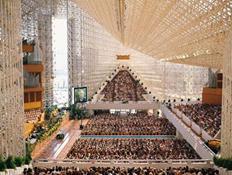

The last of the seven letters which were sent to Christian churches in Revelation, addresses a very alarming situation in which an entire congregation had already become alienated from Christ as Saviour. He is standing outside the church door and knocks to get people’s attention so that deceived churchgoers can have a personal encounter with Him, and together with that also the justification which He alone can offer them. Jesus has a solution to the most advanced forms of apostasy, and says to the congregation:
“I know your works, that you are neither cold nor hot. I could wish you were cold or hot. So then, because you are lukewarm, and neither cold nor hot, I will vomit you out of My mouth. Because you say, I am rich, have become wealthy, and have need of nothing – and do not know that you are wretched, miserable, poor, blind, and naked – I counsel you to buy from Me gold refined in the fire, that you may be rich; and white garments, that you may be clothed, that the shame of your nakedness may not be revealed; and anoint your eyes with eye salve, that you may see. As many as I love, I rebuke and chasten. Therefore be zealous and repent” (Rev. 3:15-19).
This congregation was not totally apathetic towards the Lord and His Word, but their faith was not anchored in the truth as it was based upon human reasoning and their own distorted interpretation of the Bible. Because of this, they did not observe the foundational principles of the gospel of salvation. It is evident that members of the congregation were declared to be saved by virtue of church rituals such as baptism and confirmation. Their popularity in society, their big church and great wealth were seen by them as proof of the Lord’s blessings, and because of that they became extremely presumptuous. They openly stated: “I am rich, have become wealthy, and have need of nothing” (Rev. 3:17). They were enchanted by the deceptive appearance of success and did not pursue spiritual experiences such as a personal meeting with the Lord Jesus, neither rebirth nor sanctification.
The absence of Jesus in this church is evident from two perspectives: the congregation did not abide in Christ by truly following Him, but only paid lip service to Him; they had already defected from Him. From His side, the Lord Jesus spewed these people out of His mouth for effectively rejecting Him and His message of salvation. He dissociates Himself from a dead form of godliness and does not walk in their midst so as to condone their deviant behaviour and lukewarm worship. He did not come to compromise but to save sinners from their unrighteousness and deceptive religious pretence.
The great love of the Lord Jesus for all people – including the most fallen sinners and lost sheep who wandered away very far from the flock – moves Him to have compassion on them by again calling them to repentance despite their human arrogance. He stands outside the church door and knocks as the formalistic church activities were not conducive to any real spiritual fellowship with Him. Because of this situation he withdrew Himself from them. His call is extended to individual members to open the door of their hearts to Him so He can enter in to change their lives and feast with them.
That is exactly what is happening today – certain individuals in apostatised churches react to the call of the Lord Jesus to be saved, and then go out from among those who only have a form of godliness. The apostatised churches as such do not repent in order to be spiritually restored. Their extensive power, influence and wealth motivate them to continue with their humanistic form of Christianity, which is in reality a manifestation of rebellion against evangelicalism. The biased presentation of Jesus in their congregations will eventually cause them to become victims of “another Jesus” who is described by the Bible as “the Antichrist” (1 John 2:18).
Examine yourself
We need to examine ourselves before the Lord (2 Cor. 13:5). The important question is: where do you stand personally in your life of faith? Do you wander away from the truth together with the majority who continuously lower spiritual standards by opening the door to deception? Or do you find yourself among the evangelical minority who seriously regard the Lord’s command to finish the spiritual race as overcomers? The Lord Jesus equips and empowers us to prevail against all the enemy’s attacks, all moral sins, and all forms of theological deception. The truth of the gospel has a liberating power which can make us more than conquerors in Christ Jesus (John 8:32).
At the end of the church dispensation we will be called up by the sounding of the trumpet to be in the presence of the heavenly Bridegroom. The sudden absence of the evangelical church, although relatively small, will be severely felt on earth. The true church is the body of Christ and the temple of the Holy Spirit, and by virtue of that they are the light of a dark world and the salt of a corrupt earth. Their presence on earth keeps the Antichrist from being revealed (2 Thess. 2:6-8). After their departure (Luke 21:36; 1 Thess. 4:16-18), most of the deceived people will become followers of the false christ who will reveal himself after his withholder has been taken out of the way by the Lord. During this late hour of the church age we have limited time to put right what has gone wrong in our lives.
After the church dispensation has expired a time of judgement will follow – not only for believers before the judgement seat of Christ but also for unbelievers and nominal Christians who will be subjected to the judgements of the day of the Lord on earth (Isa. 13:9; Rev. 6:15-17). During this dark period in world history, both Jews and Gentiles who reject the false messiah and receive Christ as their Saviour, can still be saved (Matt. 24:21-22; Rev. 7:4-17). However, they will pay a terrible price of rejection and persecution because they did not heed Christ’s admonitions and warnings during the church age to follow the right way (Rev. 6:9-11).